
Tale of a Teenage Robot
Chapter 1: The Garden
The kids found it in the garden bed behind the hostas. I was inside making lunch when Vincent came in through the screen door, shoes still on, breathing hard.
“Dad. Dad, come look. There’s a robot in the yard.”
I almost told him to take his shoes off. That’s where my head was. Shoes on the tile. Mustard on the knife. The baby monitor doing its quiet static from Marcus’s room. But Vincent said robot the wrong way. Not excited, the way he’d say it about a toy. Confused. Like he’d found a word that didn’t belong in the yard and didn’t know what to do with it.
I put the knife down.
The neighbor kids were in the side yard, sitting in a loose circle with their Transformers spread out on the grass. They’d stopped playing. Every one of them looking in the same direction.
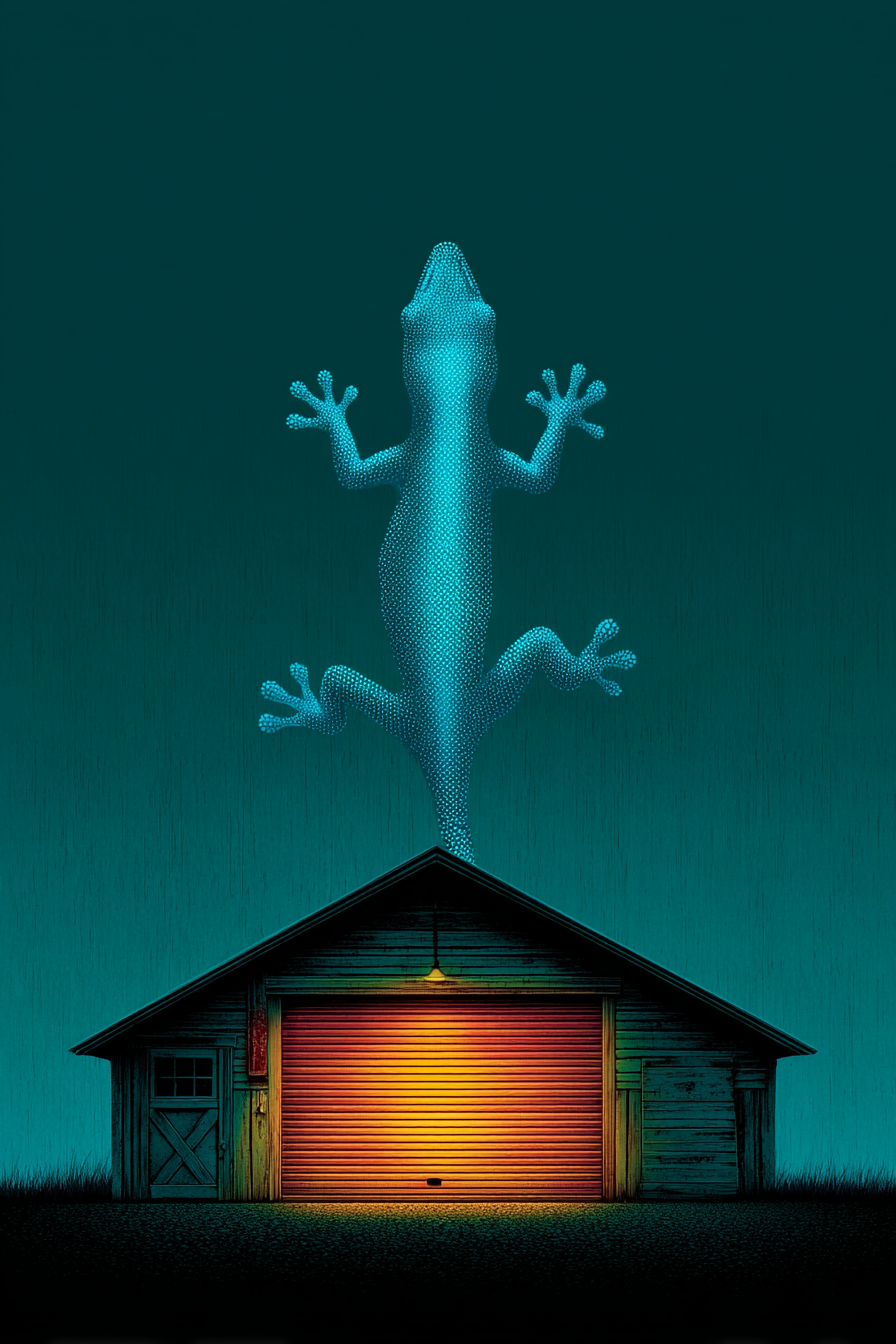
It was on the raised bed. A gecko, maybe five inches long, clinging to the cedar plank. Except it wasn’t a gecko. Or it was, but someone had dressed it. A shell of dull metal covered its body, articulated at the joints, with seams so fine they caught the afternoon light like thread. The metal moved when the gecko moved. It fit.
Nobody had built that for it. I knew that immediately and couldn’t have told you why.
“Don’t touch it,” I said. That’s what dads say when they don’t know what else to.
It turned its head and looked at me. Not the way a lizard looks at you, which is barely at all. This was direct. Focused. Like being considered.
Then it shivered and the plates shifted and the whole thing folded inward on itself, smaller and tighter, until it was the size of a walnut. It sat on the dirt like a ball bearing.
Vincent said, “Did you see that?”
I had. I just didn’t have a single useful thought about it.
Chapter 2: The Legos
It found the Legos before we found it again.
Vincent had a bin in the garage. The big mixed tub, thousands of pieces from a dozen sets he’d outgrown but wouldn’t let me donate. By the time I thought to look for the thing, it had already gotten the lid off. The lid was the snap-on kind. I don’t know how it managed.
The pieces were moving toward it. Not all of them. It was choosy. Flat plates first, then the connector pins, then the smaller technical stuff: gears, axles, the little rubber treads from a Technic bulldozer. Each piece clicked into place along its body with a sound like someone snapping their fingers very quietly, very fast. It was building itself outward, and the gecko shape was still in there somewhere, but buried under structure now. Framework.
I stood in the garage and watched for ten minutes. I should have been scared. I wasn’t. It moved with such purpose. Each piece exactly where it needed to go. I had the feeling I sometimes got watching Vincent do his math homework, that strange parental ache of seeing your kid understand something you never taught them.
By the time it stopped, it was the size of a house cat. Gecko eyes in a face made of primary-colored plastic, looking up at me from the bin. It chirped. One bright note, like a smoke detector with good news.
I went inside to think. That was the first mistake. You don’t leave something that’s growing alone in a room full of raw material.
Chapter 3: The Nursery
“Jerad! You better come see this!”
Three in the morning. Jenney’s voice from the baby’s room. Not screaming, but controlled in the way that scared me more than screaming would have. The voice she used when Vincent fell off the monkey bars. The voice that said: this is bad, and I need you to be calm about it.
I went down the hall in my boxers and saw it on the wall above Marcus’s crib.
It had climbed up there. Up the stairs, down the hall, up the wall. It was pressed flat against the drywall like a frog on glass, twice the size it had been, and the Lego pieces were gone. Buried under a layer of something that looked like skin and moved like nothing I’d ever seen skin do.
It was glowing. Soft blue-white, pulsing, and in its midsection I could see the shape of the wifi router from the hallway shelf. The Netgear logo was still readable, warped and stretched across what was becoming the thing’s chest.
“Is that the router?” Jenney said.
The baby monitor on the dresser was dead. My phone had no signal. The whole house had gone quiet in a way houses aren’t supposed to be quiet anymore, that silence you only notice when every device stops talking at once.
Marcus was awake. Lying on his back in the crib, eyes open, looking straight up at the thing above him. He wasn’t crying. He wasn’t fussing. He was just looking at it with a calm I had never seen on his face, not once in seven months, and it made me colder than anything else in the room.
“Get him out of there,” I said.
Jenney picked Marcus up. Marcus kept staring over Jenney’s shoulder, reaching one hand back toward the thing on the wall, fingers open.
It pulsed brighter. Then dimmer. Then it peeled itself off the drywall and went out the window. Left a faint brown mark on the wall in the shape of itself, like a scorch.
I didn’t go back to bed. I sat in the garage with the overhead door open, watching the yard, drinking cold coffee, waiting.
By morning it was in the garage with me. It had come in sometime around dawn. I hadn’t seen it arrive.
Chapter 4: The Garage
I need to tell you about the garage, because that’s where the rest of this happens.
Two-car, detached, which in practice means one car and everything else. Table saw. Drill press. A lathe I bought at an estate sale and used twice. Shelves of paint cans and bins of screws and jars of nails sorted by size because my father sorted his nails by size, and some things you pick up without deciding to. Workbench along the back wall. Pegboard above it. Every tool outlined in marker so you know where it goes.
My space. Saturday mornings, a podcast, maybe some sanding. That was done now.
This is where the thing grew up. I don’t have a better word for it.
By the end of the first week it was three feet tall. The Lego scaffolding had been consumed inward and replaced by a skeleton made of repurposed metal, bike chains and shelf brackets and God knows what else, wrapped in a skin that looked like silicone. When I accidentally brushed against it once it was warm. Not machine-warm. Body-warm. It had taken the wheels off Vincent’s old skateboard and now it rolled instead of crawling. It had pulled a spool of speaker wire off a shelf and threaded it through its body, loose ends dragging behind like a tail.
It rolled a lot. Clumsy loops around the garage, bumping into the workbench, knocking over a can of wood stain, backing up, trying the same loop again. There was something in the way it moved. A need to go, to do, to be where I was. Mornings when I came out with my coffee it would roll at me so fast it couldn’t stop, bang right into my shins, back up, and make that chirping sound. Louder now. And sometimes a noise that was close to a laugh.
Things went missing. A pair of pliers. A box of wood screws. The little radio I kept on the workbench. Each thing changed it. The pliers gave it something like fingers. The screws studded its surface like rivets on a boat hull. The radio was a different kind of change. After the radio it stopped chirping and started trying to speak. Garbled. Broken. Like a shortwave scanning through stations. Fragments of music. A weather report. A preacher’s cadence with no words behind it.
Steve came by one afternoon and stood in the doorway and watched it roll figure-eights around my car.
“What the hell is that?”
“I don’t know.”
“It just knocked over your paint cans.”
“It does that.”
He was quiet for a second. “Is it happy?”
It was. That was the part I couldn’t get over. It was clumsy and loud and it broke things and it was the happiest thing I had ever seen. When I said “no” after it tore a shelf bracket off the wall, it put the bracket back. Not quite right, but close. Then it looked at me the way a dog looks at you when it drops the ball at your feet. That look. Did I do good?
I started talking to it. Not because I thought it understood. Because the garage was quiet without the radio and I needed the sound of something besides it rolling into my table saw.
“You can’t keep taking things off the shelves.”
It tilted its head. It had a head now, more or less, a bulge at the top of its torso. It tracked me when I moved. It made a sound like a dial tone.
“I mean it.”
It rolled to the pegboard and carefully, very carefully, removed a crescent wrench from its outlined spot. Held it up to me. Offering or asking. I couldn’t tell which.
“Put it back.”
It put it back. Right in the outline. Then it chirped.
I told myself I was managing the situation. Managing was what I did. I managed projects at work. Managed the household calendar. Managed Vincent’s boyscouts and Sebastian’s wrestling. This was one more thing.
You can’t manage something that’s growing faster than you can understand it. I know that now.
Jenney came out to the garage that night after the kids were down. She stood in the doorway, arms crossed, watching the thing roll slow circles around the car. It chirped at her. She didn’t chirp back.
“That thing was in Marcus’s room,” she said.
“I know.”
“It ate our router.”
“I know.”
“So what are we doing, Jerad?”
I didn’t have an answer for that. I told her I was watching it, that it seemed harmless, that I’d figure something out. She looked at me the way she looks at me when I say I’ll fix the dryer and we both know I mean next month.
“Figure it out soon,” she said. She went back inside.
She was right. I just didn’t figure it out the way either of us expected.
Chapter 5: Don’t Need You
The last few days before the change, it got quiet. Not silent — it still rolled around, still absorbed things when I wasn’t looking — but it stopped coming to the door when I arrived in the mornings. Stopped banging into my shins. The chirping thinned out, then stopped altogether. It would sit at the back of the garage near the workbench, facing the wall, and I’d talk to it and get nothing back. Like a signal fading out.
I told myself it was a phase.
It happened on a Tuesday. I remember because I’d dropped Vincent at school and I was thinking about the Henricks estimate that was due by end of week and I walked into the garage with my mind somewhere else entirely and there it was.
Five and a half feet tall. Standing upright. Two arms, two legs, a torso, a head.
The skin had thickened and gone a grayish pink that was almost the color of flesh and missed by just enough to make my stomach clench. Arms too long. Shoulders too narrow. Head a little too big. The face was smooth, featureless, except for two dark spots where eyes should have been and a thin crease that could have been a mouth. One side of its jaw was slightly heavier than the other, like a face reflected in a spoon.
Like a mannequin. Close enough to a person that your brain tried to accept it and then immediately pulled back.
It was standing at my workbench. It had shed the skateboard wheels in the night. I found them later under the bench, split open and hollowed out, like shed shells.
“Good morning,” I said. Because what else do you say.
It turned. The movement was smooth. Controlled. No more bumping into things. It looked at me with those dark spots and the crease opened and it said, in a voice like something dragging over gravel:
“Don’t need you.”
My coffee got cold in my hand.
“Excuse me?”
It turned back to the workbench. Its hands were wrong. Long fingers. Too many joints. I couldn’t see what it was doing.
“Hey. Can I talk to you for a second?”
Nothing.
“Can I talk to you? Please? Just a minute?”
It looked at me over its shoulder. Even without features I could read the expression. I’ve seen it on Vincent’s face a hundred times when I tell him to clean his room. But this was colder. This wasn’t annoyance. This was contempt.
“I said I don’t need you.”
I put my coffee on the shelf and walked closer. I could see the workbench now. It had my drill bit case open, the titanium set, the good one, and it was pressing the bits into its forearms. One at a time. Not absorbing them. Mounting them. Points out. They stuck out of its skin like porcupine quills.
I knew what it wanted them for. The way it angled them and tested the tips and adjusted how deep they sat. These weren’t tools. Not anymore.
“Put those back.”
Nothing.
I reached past it and took the case. Closed it. Hung it on the pegboard, up high, on the hook where the level usually goes. My hands were steady. I was proud of that later.
“You don’t need those.”
It watched me hang the case. Didn’t try to stop me. Just watched.
I went inside. I made Vincent’s lunch. Changed Marcus’s diaper. Normal things, and I did them slowly, the way you do normal things when the normal is the only thing holding. When I came back out two hours later, the drill bit case was gone and the hook was bent upward like a finger.
It was at the back of the garage. Facing the wall. Arms at its sides. The bits caught the light when its shoulders rose and fell. It was doing something that looked like breathing and sounded like a small motor cycling on and off.
It didn’t turn around.
I stood there a long time. Looking at the bent hook. Trying to remember when it had stopped chirping.
Chapter 6: Twelve Feet
I was still looking at the hook when I felt it. Pressure behind my eyes, faint, like the start of a sinus headache. And a sound that wasn’t quite a sound. More like the air in the garage had changed key.
I decided to go inside. Call Steve. Get out of the garage for a while.
I turned toward the door. The regular door, the one to the side yard. Twelve feet from the workbench. I’ve walked it ten thousand times.
I walked twelve feet. Then I walked twelve more.
The door wasn’t closer.
Same shelves. Same concrete. Same fluorescent tubes overhead. The door was right there. I could see the daylight under it. But the space between me and it kept going, stretching, the same twelve feet of garage cycling past me over and over. Same paint cans. Same jars of nails. Like a treadmill.
I stopped. Turned around. The workbench was right behind me.
I walked toward the door again. Twenty steps. Thirty. Nothing changed.
My chest went tight. I tried the wall. Ran my hand along the cinder block, counting shelf units, looking for the seam where the side door’s frame should be. The wall was solid. Unbroken. I could see the door ten feet ahead of me and I could feel the wall where the door should have been and they were not in the same place.
I tried to think. The dimensions were wrong but the objects were right. Same shelves, same cans, same everything. It was like the room had been copied and pasted, the same twelve feet repeating on a loop, and I was walking through the copies.
I told myself it was a trick of the light. Then I told myself I was tired. Then I told myself four or five other things that weren’t true and I stopped bothering because the pressure was worse now. Not faint anymore. A hum in my sinuses. The garage was vibrating at a frequency just below what I could hear, and it was coming from behind me, from the back of the garage, from the thing standing at the wall.
It was in my head.
The router. The wifi signal it had swallowed. All those invisible waves that used to carry data through my house, room to room, device to device. Inside that body now. Repurposed. Pointed at me. Not carrying information anymore. Carrying space. False distance, fed straight into whatever part of my brain decided how far away the door was.
I sat down on the concrete. Closed my eyes.
“I know what you’re doing.”
The hum shifted. Slightly.
“Let me leave.”
Nothing.
“Please.”
The fluorescent tubes buzzed. The concrete was cold through my jeans. Twelve feet to the door. I could hear the sprinkler running in the yard on the other side of it.
That’s when I heard the scraping.
Chapter 7: The Second One
It came around a corner that didn’t exist. The garage has four straight walls. No corners to come around. But there it was, rounding a bend in a room with no bends, and it was not the same one.
Shorter. Cruder. Humanoid from the chest up, a mess of tangled wire and skateboard wheels from the chest down. Same grayish pink skin but it didn’t fit. Loose, sagging, like clothes on a wire hanger. And wet. The skin was coming off it in long drips that changed color on the way down. Pink. Gray. Green. A purple so dark it was almost black.
It saw me and lunged. Like a shopping cart with a seized wheel. That sound.
I went backward fast. It was slow. I could stay ahead of it without running. But looking at it did something to me I wasn’t ready for. The original was wrong in a way I’d gotten used to. This one was wrong in a way that felt like a mistake in the world. Like seeing something that shouldn’t have been assembled and knowing it anyway.
The original had built this. In the back of the garage, out of its own shed parts and whatever it could reach. A secret. Its kid.
The melting one came at me with hands that were barely hands, fingers fused in places, pulling apart in others with sounds I don’t want to describe. Its mouth was too wide and it was open and making a noise like laughter. High. Mechanical. Giddy. It was happy the way the original used to be happy, back when it was small and rolling into my shins. But this was that happiness with the dial broken off. All want. No sense.
I circled a shelf unit. It followed, smearing color on everything it touched. It wasn’t trying to hurt me. It was trying to get to me. The same way the original used to. Too fast, no control.
But the original had learned. This one couldn’t.
And near it, my head was clearer. The pressure was still there but thinner. Farther away. Like the original’s signal couldn’t reach as well through this thing’s noise. The duplicate was too crude to hold the field. It didn’t have the hardware.
I could think near this one. So I thought.
Chapter 8: Shop Rags
Shop rags. Top shelf, maybe real, maybe the garage looping again. A bag of the thick white kind, the ultra-absorbent ones I bought in bulk packs for cleaning up stain and poly. Like industrial diapers.
The duplicate was still behind me. Lurching, dripping, laughing that broken laugh. It had gone through a shelf of paint cans and now it was rolling through the spill, the colors soaking into its skin, which went from gray to a dozen shades at once. Like a bruise that couldn’t decide what color to be.
I’d been watching the original for weeks. Everything it ate changed it. Became part of it. Tools made it purposeful. Electronics made it sharp. The drill bits made it mean. Every object it consumed pushed it toward whatever that object was for.
So what happens when you feed it something that isn’t for anything?
Shop rags. No moving parts. No signal. No purpose except to soak things up. The most passive, characterless objects in the garage.
I pulled one out. The duplicate’s eyes found me. Smeared dark spots, low resolution, but locked on.
I held the rag up to my mouth and pretended to eat it. Tore off a piece. Mimed chewing. Rubbed my stomach. I felt like an idiot. I looked like a man doing a bit for a baby in a high chair, except the baby was a melting robot the size of a ten-year-old.
It worked. Of course it worked. This thing was built from imitation. Copies of copies. It wanted to be what it saw.
It surged at the rag. I dropped it and the duplicate fell on it, whole body, and the material disappeared into that dripping skin like water into dry sand. It made a sound. Low. Satisfied. Hungry.
I dropped another. And another. It ate them faster each time, skin stretching and pulling tight as it sucked the material in. With each rag it dimmed. The colors faded. The movement slowed. The features softened and blurred. It was becoming what it ate. Passive and dense and nothing at all.
I poured mineral spirits over the next rag. Casual. Like putting dressing on a salad. Dropped it. The duplicate didn’t hesitate.
Another rag. More spirits.
Another.
The wire-and-fiber stuff on its head went white. The skin thickened and compressed. It was shrinking but not losing anything. Same mass. Smaller package. Denser with every rag and every ounce of solvent it didn’t know it was swallowing.
I kept feeding it. Kept pouring.
When the bag was empty it was the size of a football. Heavy as a bowling ball. A tight white lump on the concrete floor, pulsing faintly, smelling like a gas station in August.
Chapter 9: You Made This
The garage was the right size again. I could feel it. The door was twelve feet away and twelve feet away.
The original was at the back of the garage. Standing very still. The way Vincent stands when I come into a room he’s not supposed to be in.
The lump was on the floor between us. The original looked at it. Looked at me. Back at the lump. Its face did something. Not an expression, exactly, but a sequence of changes, the way a screen glitches through frames. Surprise. Calculation. Then nothing. A blankness that was worse than either.
“You made this,” I said.
The crease opened. Closed.
“I don’t know what that is.”
It was lying. I knew it the way you know your kid is lying, not from the evidence but from the years of watching. The duplicate was made from its cast-off parts. Assembled in some corner of the garage I hadn’t been checking. A project it didn’t want me to see.
“You built it and you hid it from me.”
Nothing. The bits in its forearms caught the overhead light.
“It’s dangerous. You know that.”
Nothing.
“It’s falling apart. It’s going to hurt somebody.”
Its head tilted. A harder angle than before. The curious tilt was gone. This was an evaluation. How much do I care about what you’re saying. The answer was on its face and the answer was: not much.
I stood there looking at it. Five and a half feet of whatever this was. I’d watched it grow from a gecko on a cedar plank. It had chirped at me. Rolled into my shins. Held up a wrench like a gift and waited for me to say it did good, and I had, every time, and it had kept growing, and now here we were.
“I tried,” I said. “You know I tried.”
The crease twitched. Not a word. Not even close. But something moved behind those dark spots, some flicker of recognition, and then it was gone and the blankness was back.
I looked at the lump. White. Soaked through. The mineral spirits had been absorbing for ten minutes.
“I have to do this.” I don’t know if I was talking to it or to myself.
I struck a match.
Chapter 10: The Burning
Small flame. Blue. Almost gentle, skating across the surface of the compressed lump. The spirits caught and spread in a thin, even film. For a second it looked like a votive candle. Contained. Almost peaceful.
“Get back,” I said. Steve was in the doorway. He must have heard the commotion and come through the side door. Jenney was behind him with Marcus on her hip and Vincent pressed against her side.
“Farther. Get back farther.”
They moved. The flame stayed small. I thought maybe the density would smother it. Maybe it would burn out on its own.
The lump cracked.
Split down the middle like an egg and the flame found the center, where the rags were tightest, where the spirits had pooled and been compressed down into something more concentrated than I’d meant. The fire didn’t go up. It went out. Sideways. Every direction. Burning rags sprayed across the concrete, trailing flame, spattering the walls and workbench and floor like someone had kicked over a bucket of something awful. A piece hit the pegboard. Another caught the shelf with the poly cans.
Melting plastic. Scorched cotton. And something else underneath, chemical, alien, not from anything I’d put in.
“NOW! Get back NOW!”
We ran. Vincent was crying. Jenney was pulling him by the arm. Marcus wasn’t making a sound. He was watching the garage over Jenney’s shoulder with that same calm from the nursery, not even a year old and looking at the fire the way you’d look at a sunset.
The garage didn’t burn down. Concrete and cinder block don’t burn. But for five minutes it was an inferno behind the roll-up door, smoke forcing itself through every seam and gap, and the sound of paint cans and solvent bottles popping off inside like small-caliber rounds.
Then it stopped. Not died down. Stopped. The way a kid stops screaming mid-breath. Silence so sudden it had weight.
Chapter 11: It Should Have Listened
The original was standing in the middle of the garage.
Untouched. Clean concrete in a circle around its feet, black char everywhere else. The fire hadn’t reached it. Or it had moved. Or it had done something I didn’t have a word for.
It was looking at the spot where the duplicate had been. There was nothing there. Not ash. Not residue. The rags had burned. The solvent had burned. Whatever was left of the gecko underneath had burned with them.
It looked at me.
I waited for the drill bits. I waited for the pressure behind my eyes, the hum, the distance. I set my weight and waited.
It looked at me the way Vincent did the morning I told him the goldfish had died. He was six. He didn’t cry. He just looked at me and I could see him understanding that I’d forgotten to feed it. That I knew he knew. That there was nothing either of us could do about the fish now.
That’s what was on the original’s face. Not anger. Just the slow, clear understanding that something had been destroyed because somebody hadn’t listened when they could have.
And the somebody was not me.
It turned its head. The crease moved. No sound. The spots where its eyes were deepened, and the drill bits in its forearms clicked inward, one by one, retracting into the skin until they were gone.
I’d been asking it for weeks. Can we talk. Please. Just for a minute. And it shut me out. Every time. It hid the duplicate instead. Built something in secret rather than say a word to me. And now that thing was gone and the garage was black and the only one in the room who could have prevented any of it was standing in a circle of clean floor looking at ash.
I didn’t say anything. There was nothing I could say that it wasn’t already saying to itself.
It stepped toward me. Stopped. Looked at the scorch marks. Looked at me.
I saw it then. In the tilt of its head and the way its arms hung and the stillness of it. I’d been waiting for this since the morning it told me it didn’t need me.
It should have listened.
We stood in the wrecked garage, smoke still hanging in the air, and I thought we might finally understand each other. I didn’t trust it. I don’t know if I ever will. But understanding is somewhere to start.
My coffee mug was on the shelf by the door, covered in soot. I picked it up.
“Come on,” I said. “Let’s go inside.”
It followed me. Carefully. Without bumping into a single thing.
In the driveway, Jenney was holding Marcus tight. Marcus was quiet. Looking past me at the thing walking out of the garage. That same calm. That same focus. Like they understood each other in some way I was never going to be part of.
I didn’t ask about it. Some things you’re better off not knowing.
Author’s Note
This story was built from a dream, and as such, doesn’t always make sense. Why was the main character so calm? Why weren’t they more worried about some random robot evolving in their garage? Did they really feel safe enough not to report these disturbing events? But then dreams are also interpretive events, and I have to wonder if my mind was drawing parallels to the events unfolding with AI these days. We’ve invited this teenage super-intelligence into our lives like it’s no big deal, and it’s evolving… and we accept it, without horror, because it’s not physical, not… real? I don’t know. But I hope you enjoyed the story, and if you have thoughts on the underlying meanings, feel free to email me about them. Subject: Tale of a Teenage Robot.