
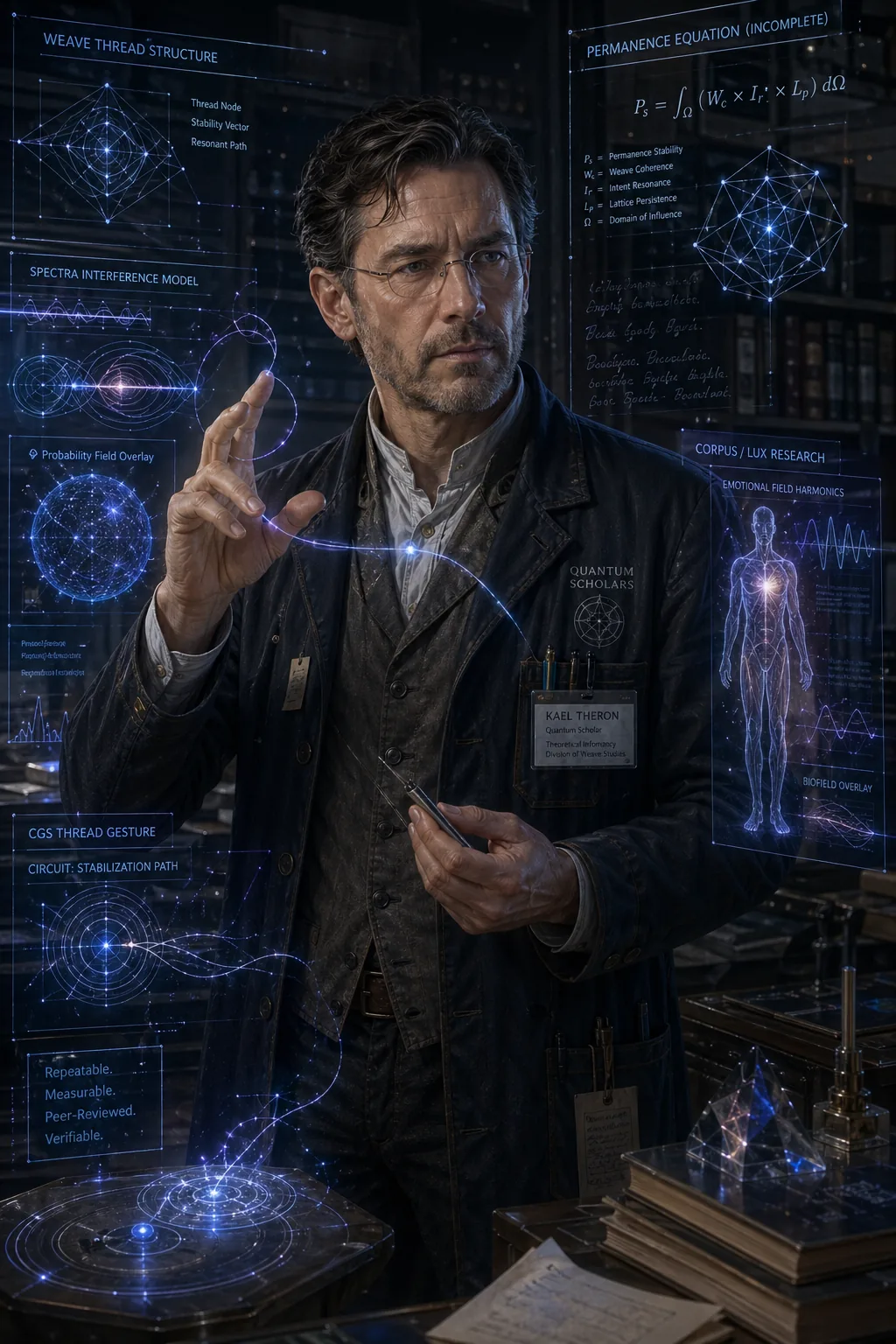
Kael Theron
Lead Researcher, Quantum Scholars Consortium
Sc1: Infomancy + Sc5: SpectraIt's a Fifthday afternoon in the long lab on the third floor of the Consortium and Kael Theron is narrating his own hands. "Initiate information capture, frequency alpha-seven, maintain observer state." He says it the way other people say good morning. The holograph above his bench unfolds into pale blue lattices, a thread interaction from forty hours ago replayed in light, and he leans in close enough that his reading glasses slide down his nose. He's forty-eight. He is the most-cited Weaver researcher alive. His fingers are stained with ink because he still takes notes by hand when something is interesting, and almost everything is interesting.
The work
His primary disciplines are Infomancy at master level and Spectra at advanced. Most researchers pick one and call themselves done. Kael uses them in concert, which is how Quantum Trace Analysis exists at all. The technique replays recent Weave manipulations in an area as a holographic record: what disciplines were used, the approximate thread capacity of the Weaver, the mental signature they left behind. It works on workings up to forty-eight hours old. Security across all five schools uses it now to replay recent Weave manipulations in the field.
His other showpiece is Multi-Discipline Resonance Mapping, four disciplines held at low power simultaneously so their interference patterns become visible in real time. It requires the kind of mental control most practitioners can't sustain past a few seconds. Kael runs it as a teaching demonstration and forgets that what he's doing is supposed to be impossible. Underneath all of it sits The Theron Protocol, his framework for testing permanence claims, which has now passed five hundred attempts under controlled conditions and become the gold standard for the field. Over the years he's also identified seventeen new thread interaction patterns that hadn't been described in the literature before he sat down to look.
The Theron Codex, his eight-hundred-page foundational text, is on the required reading list at every school in the world. One hundred and forty-two peer-reviewed publications carry his name. He still thinks of the Codex as a draft and pencils marginalia into his own copy whenever a new student asks a question he hasn't accounted for.
His CGS is precise, academic, almost pedagogical. He annotates his own gestures while performing them, narrating each transition aloud the way a surgeon might call out steps. He speaks his commands in lab-protocol cadence: clinical, structured, full of qualifiers. His Focus is built on Clarity and Detachment, which let him observe a working without nudging it, and his mental signature is described in the literature as crystalline and precise, like organized lattices in mathematical space. What he can't do is Empathy or Flow. He's tried. He cannot let go of the watching long enough to be inside the work.
Where he stands
As Lead Researcher of the Consortium's Interdisciplinary Theory Department, he sits at the center of a network he largely built. The first permanent cross-school research consortium was his project, assembled over a decade of long meetings with people who initially didn't trust him and listened until they did. Most of the senior faculty of his generation said it could not be done. He calls it his diplomatic work. The people who watched it happen call it the thing that quietly changed the field.
He is, by reputation, the neutral broker between schools. Practitioners who would not be in the same room with each other will both take a meeting with Kael. He is patient and methodical and will spend years on a single question, which makes him useful to people who need a third party who isn't going anywhere. He co-authors with Mira Caldwell when their interests align — the two of them were research partners for years before he left the Restoration Academy for the Consortium, and the papers they produced together are still cited whenever someone wants to argue about healing.
His teaching is famous in a particular way. He's better at teaching graduate students how to think than how to cast. They struggle for a year. Then they don't. Alumni from his lab show up at every major institution, and they keep writing him letters about the work they're doing now, and he keeps every one of them.
What he looks like working
Medium build, somewhat neglected fitness, the posture of a man who has spent decades leaning toward a bench. Reading glasses he's had since he was twelve. He could have them corrected by any second-year Corpus student in an afternoon and refuses, gently, every time it's offered. I've had them since I was twelve, he says, as if that settles it, and to him it does. Academic robes with pockets that bulge and crinkle because there is always at least one folded scrap of paper in each of them. Ink on his fingers, sometimes on his cuffs, occasionally a small smudge along the side of his nose he doesn't know is there.
He speaks in complete, structured sentences with hedge words tucked in like punctuation: approximately, suggests, potentially, within the bounds of current measurement. When he's excited about something he sounds about fifteen years old. When he's tired he sounds like a textbook reading itself aloud. He explains more than necessary. He is oblivious to the moment when the eyes of the person he's talking to glaze over, and he will keep going for several minutes past it, happily, into the part of the explanation he finds most interesting.
If you want to find him, look for the lattice. Late afternoon, the holograph unfurled above his bench in pale blue, his hand tracing one of the threads in mid-air while he murmurs to himself about a resonance he didn't expect. Across the hall, a graduate student is leaving with a borrowed copy of the Codex tucked under one arm, the spine already starting to crease.